
Choosing medical equipment is a major decision for any healthcare facility. The right equipment can support daily operations, meet clinical needs, and provide dependable performance over time. However, buying based only on price or availability can create problems later.
Medical device sales should be approached as more than a simple purchase. Healthcare facilities should consider the equipment’s intended use, specifications, compatibility, condition, reliability, total cost, parts availability, and ongoing service support. Evaluating these factors before buying can help facilities make informed decisions and avoid unnecessary equipment downtime.
How Do Healthcare Facilities Choose Medical Equipment?
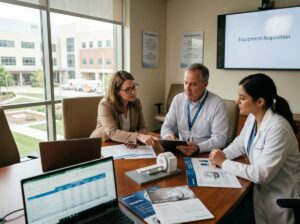
Healthcare facilities have different needs, so there is no single piece of equipment that works best for every organization. Before purchasing, facility managers and purchasing teams should first understand how the equipment will be used and what the facility expects from it.
Key factors include:
- Clinical and operational needs
- Equipment specifications
- Compatibility with existing systems
- Equipment condition
- Reliability and performance
- Purchase and ownership costs
- Parts availability
- Maintenance requirements
- Repair options
- Supplier support
A careful evaluation helps ensure that the equipment fits the facility rather than forcing the facility to adapt around an unsuitable device.
Start With Your Facility’s Clinical and Operational Needs
Begin by identifying the equipment’s intended purpose.
Consider which department will use it, how often it will be used, the required features, patient volume, available space, and other operational requirements. A device that works well in one healthcare setting may not be suitable for another.
This step can also help prevent unnecessary spending on features that the facility does not actually need.
Review Equipment Specifications and Compatibility
Before purchasing, review the manufacturer’s specifications and determine whether the equipment will work with the facility’s existing environment.
Consider factors such as:
- Power requirements
- Physical dimensions
- Accessories
- Connectivity
- Existing equipment
- Required components
- Manufacturer requirements
Compatibility is particularly important when adding equipment to an existing clinical or technical environment. The FDA also recommends considering electromagnetic compatibility when purchasing, installing, and managing medical and electronic equipment in healthcare facilities. (U.S. Food and Drug Administration [FDA], 2023)
Evaluate Equipment Condition and Reliability
Equipment condition is especially important when purchasing used or refurbished medical equipment.
Facilities should consider more than how a device looks. Ask about its service history, functional condition, inspection, testing, previous repairs, and availability of replacement parts.
A well-evaluated piece of equipment can provide value, but facilities should understand exactly what they are purchasing and what support will be available afterward.
What Should Healthcare Facilities Consider Before Buying Medical Equipment?

Once the facility understands its basic requirements, the next step is to compare available equipment options.
Consider Equipment Performance
The equipment should be capable of performing the functions required by the facility.
Review its specifications and determine whether it can support the intended application. Where appropriate, facilities should also consider testing and performance verification before equipment is placed into service.
Consider Maintenance and Service Requirements
Medical equipment needs support throughout its useful life.
Depending on the equipment, facilities may need:
- Preventive maintenance
- Functional testing
- Performance checks
- Calibration
- Repairs
- Replacement parts
- Service documentation
The FDA notes that many reusable medical devices require preventive maintenance and repair during their useful life and that proper servicing is critical to their continued safe and effective use. (U.S. Food and Drug Administration [FDA], 2024)
Check Parts and Equipment Availability
A device may meet today’s requirements but become difficult to maintain if replacement parts are no longer available.
Before purchasing, consider whether essential components, accessories, and replacement parts can be sourced when needed. This is particularly important for older or specialized medical equipment.
Medical Device Sales: How to Choose the Right Equipment for Your Facility
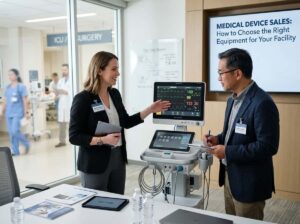
Medical device sales should focus on the overall value of the equipment, not simply its purchase price.
When comparing options, consider:
- Does the equipment meet the facility’s needs?
- Is it compatible with existing systems?
- What condition is it in?
- Are replacement parts available?
- How will it be maintained?
- Can it be repaired?
- What will it cost to operate over time?
- Does the supplier offer technical support?
These questions can help purchasing teams make a decision based on long-term equipment needs rather than short-term cost.
Should You Buy New, Used, or Refurbished Medical Equipment?
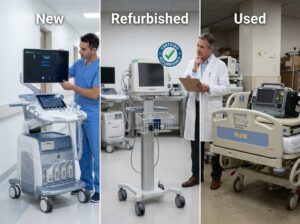
Healthcare facilities may have several purchasing options. The best choice depends on the equipment, application, budget, and support requirements.
When New Medical Equipment May Be the Right Choice
New equipment may be appropriate when a facility needs the latest available technology, current features, manufacturer support, or a new warranty.
However, new equipment is not automatically the best option for every facility.
When Used Medical Equipment May Make Sense
Used equipment can provide another option for facilities working within a specific budget or looking to replace equipment without purchasing a brand-new system.
Before purchasing used equipment, review its condition, functionality, compatibility, service history, and parts availability.
When Refurbished Equipment Can Be a Practical Alternative
Refurbished medical equipment can offer a middle ground between new and used equipment.
Depending on the equipment and supplier, refurbishment may include inspection, cleaning, replacement of worn components, repair, functional testing, and performance checks.
Facilities should ask what refurbishment work was performed and what testing or documentation is available.
How Much Does Medical Equipment Really Cost?
The purchase price is only one part of the cost.
Healthcare facilities should also consider the total cost of ownership, which can include:
- Purchase price
- Installation
- Accessories
- Replacement parts
- Preventive maintenance
- Repairs
- Testing and calibration
- Equipment downtime
- Expected service life
For example, equipment with a lower upfront price may become more expensive over time if replacement parts are difficult to find or repairs are frequent.
Looking at the complete equipment lifecycle can help facilities make more practical purchasing decisions.
Why Parts and Service Availability Matter Before You Buy
A medical equipment purchase does not end when the equipment arrives.
Facilities may eventually need replacement parts, repairs, preventive maintenance, testing, or other technical support. Planning for these needs before purchasing can help reduce unexpected problems later.
This is particularly important when facilities rely on older or specialized equipment. A supplier that can help with both equipment sourcing and ongoing biomedical equipment services can provide additional value throughout the equipment lifecycle.
What Makes a Reliable Medical Equipment Supplier?
A reliable supplier should provide more than product availability.
Before choosing a provider, consider whether it can assist with:
- Equipment sourcing
- New equipment
- Used equipment
- Refurbished equipment
- Replacement parts
- Equipment inspection
- Functional testing
- Repairs
- Preventive maintenance
- Service documentation
It is also useful to consider what happens after the sale. Equipment support can be an important part of maintaining reliable healthcare operations.
Medical Equipment Sales and Sourcing for Healthcare Facilities
Healthcare facilities in Syracuse and surrounding Central New York communities may face challenges when looking for specific equipment, replacement parts, or alternatives to new equipment.
Syracuse Biomedical Services provides medical equipment and parts sales alongside its broader biomedical equipment services. The company offers new, used, and refurbished equipment and parts and can assist with sourcing older or hard-to-find equipment and components.
This approach gives healthcare facilities an option to address both immediate equipment needs and longer-term service requirements.
New, Used, and Refurbished Equipment Options
Facilities can evaluate different equipment options based on their budget, intended use, availability, and long-term support needs.
Syracuse Biomedical Services provides access to new, used, and refurbished equipment and parts, helping facilities explore options that may fit their specific requirements.
Sourcing Hard-to-Find Medical Equipment and Parts
Older equipment can remain useful even when finding replacement components becomes challenging.
Syracuse Biomedical Services supports equipment and parts sourcing, including older and hard-to-find items. This can help facilities maintain existing systems instead of immediately replacing equipment when a specific component is difficult to obtain.
Equipment Inspection, Testing, and Service Support
Equipment sourcing should also consider what happens after the purchase.
Syracuse Biomedical Services provides biomedical equipment maintenance, testing, repair, calibration support, and documentation services. Combining equipment sales with technical support can help facilities manage equipment beyond the initial transaction.
Find the Right Medical Equipment for Your Healthcare Facility
Choosing medical equipment requires more than comparing prices. Facilities should consider performance, compatibility, condition, parts availability, maintenance, repair, and long-term support before making a purchasing decision.
Whether you need new, used, or refurbished equipment—or are searching for hard-to-find medical equipment parts—Syracuse Biomedical Services can help you explore equipment sales and sourcing options for your facility.
Contact Syracuse Biomedical Services today to discuss your medical equipment needs and find a solution that fits your facility’s requirements.


