Choosing the right infusion pump is more than selecting a device that can deliver fluid. Healthcare facilities must consider the type of therapy, required flow rate, volume, patient needs, clinical setting, and the condition of the equipment.
Understanding the types of infusion pumps can help healthcare teams make better equipment decisions. Among the available options, volumetric infusion pumps are commonly used when controlled delivery of fluids at a programmed rate and volume is needed.
But when is a volumetric pump the right choice? And what should a facility consider after the equipment is in service? This guide explains how volumetric pumps work, how they compare with other infusion pump types, and why testing and preventive maintenance are important parts of equipment management.
What Is a Volumetric Infusion Pump Used For?

A volumetric infusion pump is designed to deliver a controlled amount of fluid at a programmed rate. It can be used when healthcare providers need consistent and controlled delivery of fluids or medications through an infusion system.
Unlike gravity-based delivery, an infusion pump gives the user greater control over the rate and amount being delivered. The exact capabilities depend on the pump model and its manufacturer specifications.
The U.S. Food and Drug Administration (FDA) explains that external infusion pumps deliver fluids into a patient’s body in a controlled manner, with different types designed for a variety of purposes and healthcare environments (U.S. Food and Drug Administration [FDA], 2019).
How Does a Volumetric Infusion Pump Work?
A volumetric pump works with an administration set and fluid source to control delivery. The user programs the desired settings, and the pump moves fluid through the tubing at the programmed rate.
Different types of infusion pumps use different mechanisms to control fluid delivery. For example, peristaltic pumps use rollers that pinch flexible tubing and push fluid forward, while syringe pumps use a movable piston to control delivery (U.S. Food and Drug Administration [FDA], 2019).
The pump may also include alarms or alerts that notify the user of certain conditions, such as an occlusion or another problem affecting delivery.
Where Are Volumetric Infusion Pumps Used?
Volumetric pumps can be used in healthcare environments where controlled infusion is required. Their suitability depends on the therapy, the fluid being delivered, the required rate and volume, and the manufacturer’s instructions for use.
Because infusion pumps may be used to deliver important medications and fluids, reliable equipment performance is an important consideration. The FDA has reported that pump failures can contribute to over-infusion, under-infusion, missed treatments, or delayed therapy (FDA, 2024).
Types of Infusion Pumps: When Is a Volumetric Pump the Right Choice?

There is no single infusion pump that is appropriate for every situation. Different types of infusion pumps are designed for different delivery requirements.
The right choice depends on what the equipment needs to deliver, how it will be used, and the requirements of the clinical environment.
What Are the Main Types of Infusion Pumps?
Common infusion pump categories include:
- Volumetric or large-volume infusion pumps
- Syringe pumps
- Patient-controlled analgesia (PCA) pumps
- Elastomeric pumps
- Enteral pumps
- Insulin pumps
- Ambulatory infusion pumps
The FDA describes these as different types of infusion systems with different functions and delivery mechanisms. For example, syringe pumps use a syringe reservoir and moving piston, while elastomeric pumps use pressure from an elastic reservoir to deliver fluid (FDA, 2019).
Volumetric vs. Syringe Pumps: What Is the Difference?

A volumetric pump and syringe pump both provide controlled delivery, but they are designed differently.
A volumetric pump generally works with an administration set and is suited to controlled delivery of larger fluid volumes. A syringe pump uses a syringe as its reservoir and mechanically moves the plunger to deliver fluid.
The choice between them should not be based only on the name of the device. The intended therapy, required volume, flow rate, equipment specifications, and clinical application should all be considered.
When Is a Volumetric Pump the Right Choice?
A volumetric infusion pump may be appropriate when a healthcare facility needs controlled delivery of a defined volume at a programmed rate.
Important factors include:
| Factor | What to Consider |
| Required Flow Rate | The pump should support the required delivery range for the intended therapy. |
| Fluid Volume | The available reservoir and pump configuration should suit the application. |
| Therapy Duration | Longer or continuous therapies may have different equipment requirements. |
| Clinical Environment | Bedside, inpatient, outpatient, and other settings may have different equipment needs. |
| Patient Requirements | The equipment should be appropriate for the intended patient population and therapy. |
| Administration-Set Compatibility | The pump and compatible accessories should match the manufacturer’s requirements. |
| Equipment Condition | A suitable pump must also be properly maintained and functioning as intended. |
The key point is simple: the best infusion pump is the one that matches the intended clinical application and applicable manufacturer requirements.
When Might Another Infusion Pump Be a Better Fit?
A volumetric pump is not automatically the best option for every application.
A syringe pump may be more appropriate when delivery from a syringe is required. PCA pumps are designed for controlled patient-administered pain medication. Ambulatory pumps are designed around portability, while enteral pumps are intended to deliver liquid nutrients or medications to the digestive tract.
Understanding these differences helps healthcare facilities avoid treating all infusion equipment as interchangeable.
What Should You Consider When Selecting an Infusion Pump?
Before selecting equipment, healthcare facilities should consider:
- Intended use and therapy
- Flow-rate requirements
- Volume requirements
- Required infusion duration
- Patient needs
- Clinical environment
- Alarm and safety features
- Compatible accessories and administration sets
- Manufacturer specifications
- Maintenance and testing requirements
- Available technical support
This approach helps connect equipment selection with long-term equipment management. A pump that meets the initial need still requires proper inspection, maintenance, and performance checks throughout its service life.
Why Does Infusion Pump Testing Matter?
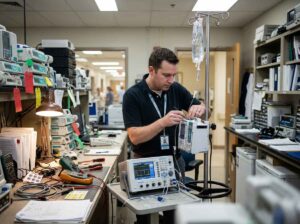
Infusion pump performance can change with equipment condition, operating conditions, and other factors. For this reason, testing should be based on the applicable requirements for the specific device.
FDA guidance on infusion pump performance testing emphasizes evaluating delivery accuracy under relevant operating conditions and across applicable flow rates. The FDA also recognizes AAMI TIR101:2021, which addresses fluid delivery performance testing for infusion pumps, including volumetric pumps (FDA, 2023; FDA, 2022).
Testing may form part of a broader biomedical equipment program that includes inspection, functional checks, calibration where applicable, preventive maintenance, and documentation.
Volumetric Infusion Pump Service, Testing, and Preventive Maintenance
Once an infusion pump is in use, equipment management becomes just as important as the original selection.
Volumetric Infusion Pump Testing
Professional biomedical equipment testing can help identify whether equipment is operating as expected and whether further service or evaluation may be needed.
Facilities should also maintain appropriate service documentation and follow the manufacturer’s recommendations and internal equipment procedures.
Preventive Maintenance for Infusion Pumps
Preventive maintenance helps healthcare facilities identify equipment issues before they become larger operational problems. Depending on the equipment and applicable requirements, maintenance may involve inspection, functional checks, performance verification, calibration, and documentation.
The goal is not simply to keep equipment running. It is to support reliable equipment performance throughout its service life.
Biomedical Equipment Repair and Support
When medical equipment develops a fault, fails a performance check, or requires additional evaluation, professional biomedical support can help determine the appropriate next step.
Syracuse Biomedical Services, LLC provides medical equipment maintenance, calibration, and repair, along with parts and equipment sales and staff augmentation services. The company also states that it can provide maintenance and repair for equipment regardless of where it was purchased (Syracuse Biomedical Services, LLC, 2026).
For healthcare facilities in Syracuse, NY, and surrounding areas, having access to ongoing biomedical equipment support can help reduce equipment-related disruptions and support effective equipment lifecycle management.
Need Biomedical Equipment Service or Support?
Understanding the types of infusion pumps is an important first step, but selecting equipment is only part of the process. Proper testing, maintenance, calibration, repair, and documentation also play an important role in managing medical equipment.
If your healthcare facility needs help with medical equipment maintenance, calibration, repair, or equipment support, Syracuse Biomedical Services, LLC can assess your requirements and recommend an appropriate service approach.
Contact Syracuse Biomedical Services to discuss your medical equipment service needs and learn how the team can support your facility.