
Portable diagnostic imaging has changed how healthcare professionals evaluate and treat patients. A portable ultrasound machine allows clinicians to perform real-time imaging at the patient’s bedside, in a clinic, or even in remote care settings. Instead of transporting patients to an imaging department, providers can bring the equipment directly to them, helping save time and support faster clinical decisions.
As these systems become more common in hospitals, physician offices, urgent care centers, and outpatient facilities, keeping them in excellent working condition is just as important as choosing the right model. Routine preventive maintenance and professional servicing help ensure accurate imaging, improve equipment reliability, and reduce unexpected downtime.
What Is a Portable Ultrasound Machine and How Does It Work?

A portable ultrasound machine is a compact imaging system that uses high-frequency sound waves to create real-time images of organs, muscles, blood vessels, and other internal structures. Unlike X-rays and CT scans, ultrasound uses high-frequency sound waves instead of ionizing radiation to produce real-time images, making it a safe imaging modality for many diagnostic applications (U.S. Food and Drug Administration [FDA], 2025).
Today’s portable systems are lightweight, battery-powered, and designed for mobility. They are commonly used in:
- Hospitals
- Emergency departments
- Urgent care centers
- Physician offices
- Surgical centers
- Sports medicine clinics
- Mobile healthcare programs
- Veterinary practices
How Does It Work?
The process is simple but highly effective.
First, a transducer (also called a probe) sends high-frequency sound waves into the body. These sound waves bounce off tissues and organs, creating echoes. The machine then processes these echoes into detailed images displayed almost instantly on the screen.
This real-time imaging allows healthcare providers to examine patients during consultations, procedures, or emergency situations without waiting for additional diagnostic appointments.
Why Portable Ultrasound Is Becoming More Popular
Healthcare facilities continue adopting portable ultrasound systems because they offer several practical advantages.
These include:
- Faster bedside diagnosis
- Reduced patient transport
- Improved workflow efficiency
- Greater flexibility for clinicians
- Better access to imaging in rural locations
- Enhanced patient comfort
Portable imaging has become especially valuable in point-of-care ultrasound (POCUS), where clinicians use ultrasound during patient assessments to guide immediate treatment decisions.
Portable Ultrasound Machine: Features, Capabilities, and Clinical Applications
Choosing a portable ultrasound machine involves more than comparing price or size. Healthcare organizations should consider image quality, clinical capabilities, reliability, and long-term serviceability.
Important Features to Look For
Modern portable ultrasound systems offer many advanced capabilities that improve both efficiency and diagnostic confidence.
Some of the most valuable features include:
- High-resolution imaging
- Color Doppler imaging
- Multiple transducer compatibility
- Touchscreen operation
- Wireless connectivity
- Long battery life
- Cloud-based image storage
- AI-assisted image optimization
- Compact, lightweight design
These features help clinicians work more efficiently while maintaining high-quality patient care.
Clinical Applications Across Medical Specialties
Portable ultrasound is now used throughout many healthcare settings.
Common applications include:
| Medical Specialty | How Portable Ultrasound Is Used |
| Emergency Medicine | Quickly assess trauma patients, detect internal bleeding, and identify fluid accumulation to support rapid treatment decisions. |
| Critical Care | Monitor critically ill patients at the bedside without transporting them away from intensive care units. |
| Cardiology | Evaluate heart function, blood flow, and cardiac structures during bedside examinations. |
| Obstetrics and Gynecology | Monitor pregnancy, assess fetal development, and evaluate reproductive health conditions. |
| Primary Care | Support faster diagnosis during routine patient visits by providing immediate imaging when clinically appropriate. |
| Sports Medicine | Evaluate muscle injuries, tendon damage, ligament conditions, and joint abnormalities to aid diagnosis and treatment planning. |
| Vascular Imaging | Assess blood circulation, detect vascular abnormalities, and evaluate blood flow using Doppler ultrasound technology. |
Because these systems deliver immediate imaging results, they often improve workflow while reducing delays in patient care.
Advantages Compared with Traditional Ultrasound System

Although traditional cart-based ultrasound systems remain essential for many advanced imaging procedures, portable systems offer several important benefits.
| Portable Ultrasound | Traditional Ultrasound |
| Easy to transport | Fixed location |
| Bedside imaging | Dedicated imaging room |
| Faster patient assessments | May require patient transport |
| Lower space requirements | Larger footprint |
| Ideal for mobile healthcare | Better for complex imaging studies |
Healthcare facilities often use both systems together, selecting the right equipment based on each patient’s clinical needs.
Why Preventive Maintenance Matters
Purchasing quality medical equipment is only the beginning. Maintaining that equipment is equally important.
Routine preventive maintenance helps healthcare organizations:
- Maintain image quality
- Detect worn or damaged probes
- Verify electrical safety
- Reduce unexpected equipment failures
- Extend equipment lifespan
- Improve equipment availability
- Support regulatory compliance
A poorly maintained ultrasound system may produce image artifacts, inaccurate measurements, or unexpected shutdowns, potentially affecting patient care.
Professional biomedical equipment technicians perform inspections, testing, calibration verification, software checks, and performance evaluations to help ensure equipment operates as intended.
The Association for the Advancement of Medical Instrumentation (AAMI) recommends using risk-based maintenance strategies that prioritize equipment based on factors such as clinical function, likelihood of failure, and patient risk. This approach helps healthcare facilities improve equipment reliability while supporting patient safety (Association for the Advancement of Medical Instrumentation [AAMI], 2017).
Signs Your Portable Ultrasound Machine May Need Service
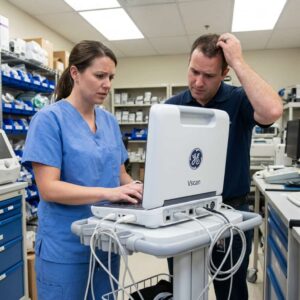
Even reliable equipment eventually requires professional attention.
Watch for signs such as:
- Blurry or distorted images
- Damaged ultrasound probes
- Battery charging problems
- Software errors
- Display issues
- Overheating
- Slow system performance
- Failed electrical safety inspections
Addressing these issues early can help avoid more expensive repairs and unexpected downtime.
Need Expert Portable Ultrasound Equipment Support? Schedule a Service Consultation
Healthcare organizations depend on reliable diagnostic equipment every day. When portable ultrasound systems perform consistently, clinicians can focus on delivering quality patient care with confidence.
At Syracuse Biomedical Services, we understand how important dependable medical equipment is to your organization. Our experienced biomedical equipment technicians provide professional inspection, preventive maintenance, troubleshooting, repair, and performance testing for a wide range of medical equipment, including portable ultrasound systems.
Whether you operate a hospital, outpatient clinic, physician practice, surgery center, or other healthcare facility throughout Central New York and surrounding areas, our team is committed to helping you maximize equipment uptime, extend equipment life, and maintain safe, reliable performance.
Preventive service not only protects your investment but also helps reduce unexpected interruptions that can affect patient care.
Conclusion
A portable ultrasound machine has become an essential diagnostic tool because it brings fast, high-quality imaging directly to the patient. From emergency medicine to primary care, these systems improve efficiency, support timely clinical decisions, and enhance the patient experience.
However, advanced technology performs best when it receives regular maintenance and professional service. Routine inspections, preventive maintenance, and timely repairs help ensure your equipment continues delivering accurate, reliable imaging for years to come.
If your healthcare facility needs dependable biomedical equipment support, Syracuse Biomedical Services is here to help. Contact our team today to schedule a service consultation and learn how our preventive maintenance and repair services can keep your portable ultrasound equipment operating at its best.
Frequently Asked Questions
1. What is a portable ultrasound machine?
A portable ultrasound machine is a compact device that uses sound waves to create real-time images of internal body structures.
2. What are portable ultrasound machines used for?
They are used for bedside imaging in emergency medicine, cardiology, obstetrics, primary care, sports medicine, and other clinical settings.
3. What are the benefits of portable ultrasound?
Portable systems provide faster bedside imaging, reduce patient transport, and offer greater flexibility for healthcare providers.
4. How often should a portable ultrasound machine be serviced?
Regular preventive maintenance helps maintain image quality, equipment reliability, and safe operation.
5. When does a portable ultrasound need repair?
Blurry images, damaged probes, battery problems, software errors, overheating, or display issues may indicate the need for professional service.


